
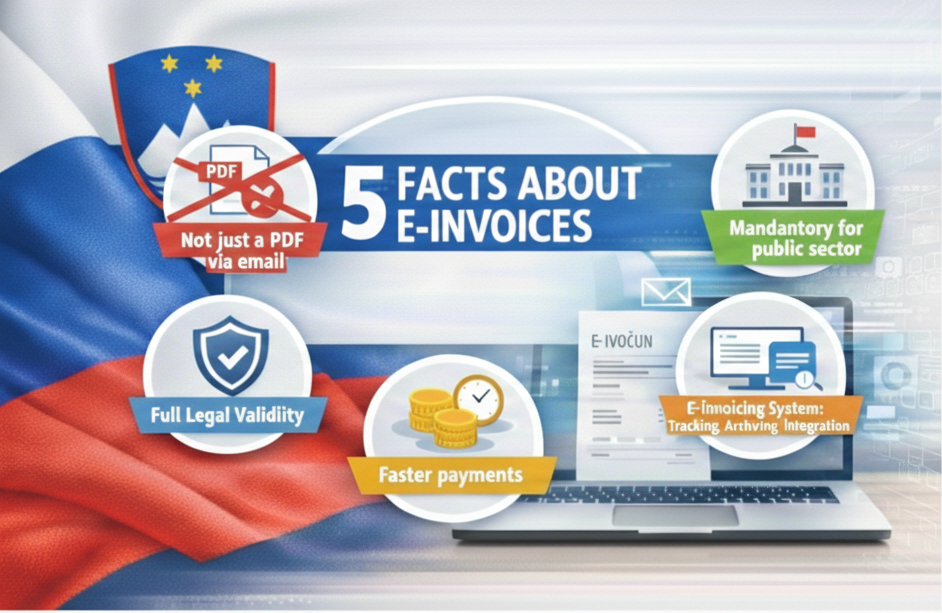
E-invoices have been the standard in Slovenia for some time, especially when doing business with the public sector. Nevertheless, questions, misconceptions, and surprises still arise in practice—for both entrepreneurs and accountants alike.
Below, we have gathered 5 interesting facts about e-invoices that many people are unaware of, yet can significantly impact daily business operations.
E-invoices have been the standard in Slovenia for some time, especially when doing business with the public sector. Nevertheless, questions, misconceptions, and surprises still arise in practice—for both entrepreneurs and accountants alike.
An e-invoice is not the same as a PDF via email
An e-invoice is not a PDF document sent by email.
A true e-invoice is:
- structured (XML),
- machine-readable,
- sent via secure electronic channels (not by email, except when the recipient is a consumer),
- capable of being automatically processed in accounting systems.
A PDF can be an attachment that visualizes the invoice, but it is not an e-invoice in the true sense of the word.
E-invoices are mandatory when dealing with the public sector
In Slovenia, sending XML e-invoices is mandatory when doing business with:
- state authorities,
- municipalities,
- public institutions,
- and other budget users via the UJP (Public Payments Administration portal / e-invoicing system).
This means that to do business with public budget users, you must use an appropriate e-invoicing solution.
E-invoices can significantly speed up payments
Companies that use e-invoices:
- reduce manual work,
- reduce the number of errors,
- often receive payments faster.
Why?
Because e-invoices enable:
- automatic bookkeeping,
- faster processing by the recipient,
- fewer complaints and rejections.
An e-invoicing system is more than just “sending invoices”
Modern systems like bizBox are no longer just tools for sending e-invoices; they also enable:
- receiving e-invoices,
- tracking statuses,
- integration with ERP and accounting software,
- digital archiving,
- greater business transparency.
Today, e-invoices are part of a broader digital transformation for companies.
E-invoices have the same legal validity as paper invoices
In Slovenia, e-invoices issued in accordance with legislation and standards (e.g., e-Slog) have the same legal validity as paper invoices.
This means that:
- they are tax-compliant,
- they can be used in audits and inspections,
- there is no need to additionally print them or keep them in physical form.