
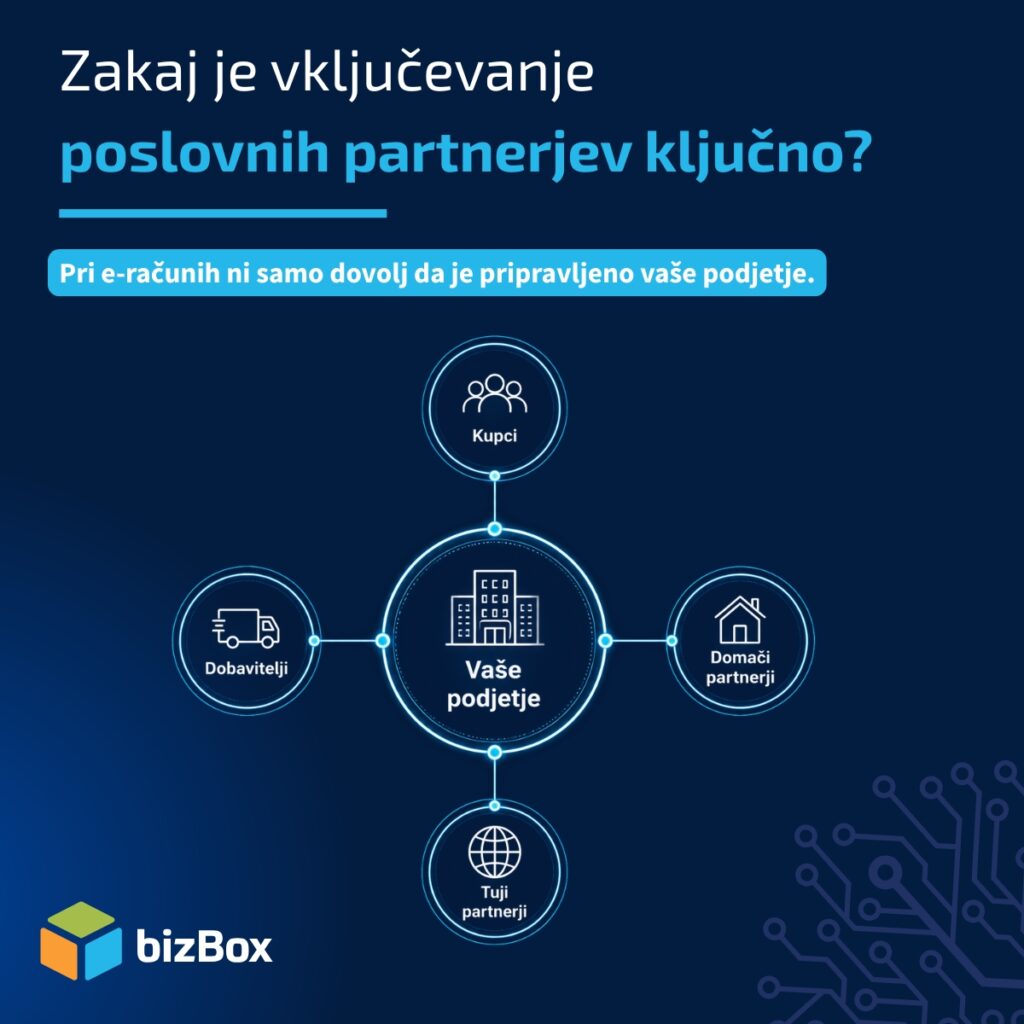
When transitioning to e-invoicing, it’s not only important that your company is prepared for the change. It is also crucial how you will exchange e-invoices with your customers, suppliers, accounting department, and other business partners. Each company may use different software, a different workflow, or a different solution for sending and receiving e-invoices. Therefore, it is advisable for companies to prepare for the transition in a timely manner and not wait until the last minute.
E-invoices are not just an internal company change
Many companies, when preparing, first think about themselves: what software they use, who will issue invoices, who will receive them, and how document processing will take place.
This is, of course, important. However, an e-invoice does not remain solely within the company. It must be sent to the customer, received from the supplier, or forwarded to the accounting department. Therefore, business partners must also be included in the exchange.
If we do not consider this early enough, problems may only arise when the process should already be operational.
Where problems may arise
Complications can occur in e-invoice exchange if companies are not coordinated with each other.
The most common problems are:
- incorrect or missing data on the invoice,
- unclear instructions on where and how to send the e-invoice,
- different software and technical settings,
- rejected documents,
- additional coordination via email or phone,
- manual error correction.
With a smaller number of invoices, this may not seem like a major issue. However, when errors start to recur, they can quickly lead to additional work, delays, and frustration for both parties.
Why it is good to involve partners in a timely manner
If a company checks in advance how partners will send and receive e-invoices, the transition is much easier. This applies to larger companies with many suppliers, as well as smaller companies that cooperate with an accounting service, regular customers, or important suppliers.
In the preparatory phase, it is advisable to check:
- with which partners you will exchange e-invoices,
- which partners are already ready,
- who needs additional instructions,
- what software or system they use,
- how you will test e-invoices,
- who will help if an error occurs.
In this way, the company knows in advance where questions may arise and how it will resolve them.
Clear instructions facilitate the transition
Communication is also very important when transitioning to e-invoicing. Business partners need to know what is expected of them, how to send or receive e-invoices, and where to turn with questions. It is good for the company to prepare brief and clear instructions. These may include basic information about the exchange method, necessary data, support contact, and an estimated timeline for the transition. This reduces the number of questions, errors, and additional manual work.
The entire circle of partners must be prepared
For mandatory B2B e-invoices, it is not enough for only your company to be prepared. The circle of business partners with whom you exchange documents must also be prepared. This includes customers, suppliers, accounting services, domestic, and in some cases, foreign partners.
Companies that involve partners in a timely manner will more easily reduce the number of errors, avoid unnecessary coordination, and ensure a smoother transition to e-invoicing.