
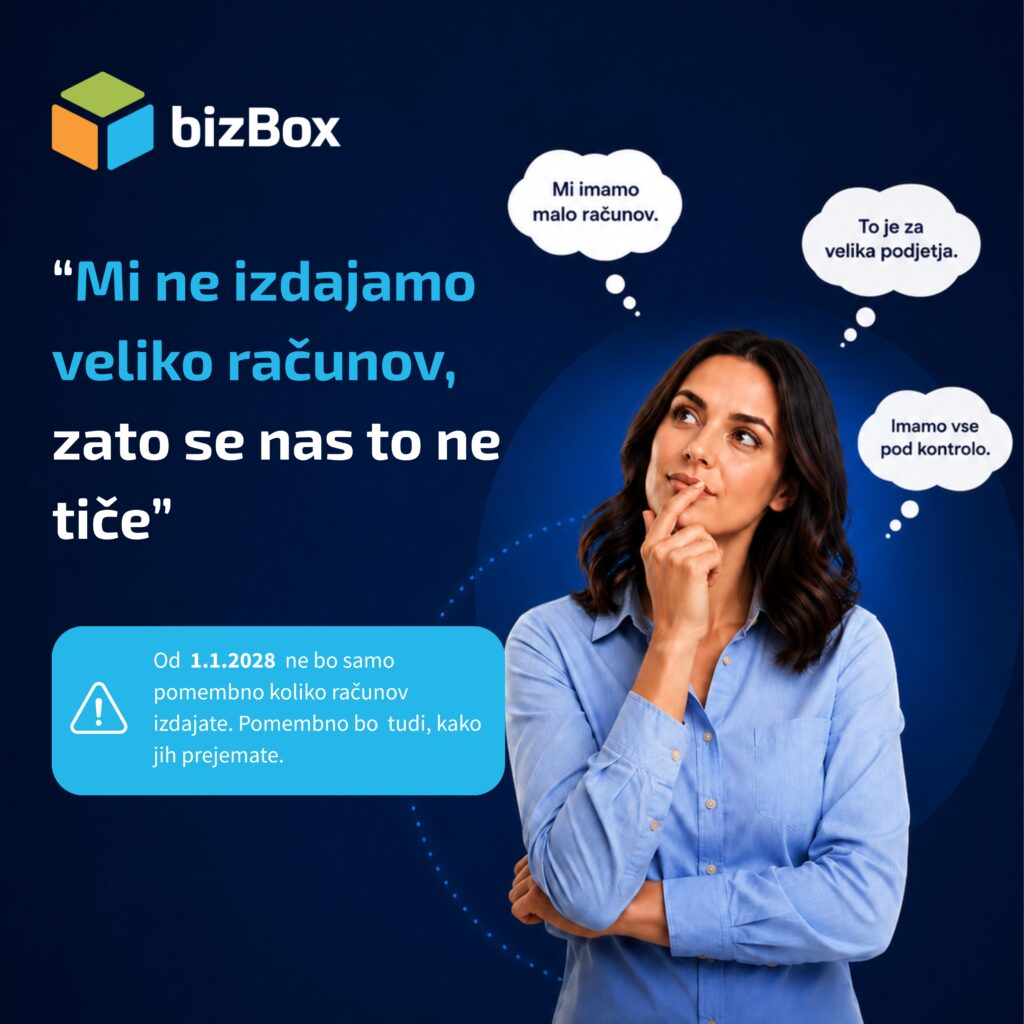
“We don’t issue many invoices, so this doesn’t concern us.”
This is one of the most common misconceptions that arises when preparing for mandatory e-invoice exchange.
Many business owners first think of issued invoices when considering this change. If a company only issues a few invoices per month, it quickly creates the impression that the change will not be particularly significant for them.
However, with mandatory e-invoices, it will not only be the issuance of invoices that matters. Their receipt will also be important.
It’s not just about the invoices you issue
From 1 1. 2028, the exchange of e-invoices between business entities in Slovenia will be mandatory. This means that companies will need to arrange in time how they will issue, receive, and process e-invoices.
The change will therefore not only affect large companies or companies that issue a large number of invoices each month.
It will also affect sole proprietors, micro, small, and medium-sized enterprises when they do business with other business entities.
Invoice receipt will also be important
In practice, a company does not only do business when it issues an invoice to a customer. A company also does business when it purchases materials, orders services, cooperates with suppliers, or takes an invoice for the company or tax number when making a purchase.
In such cases, it will also need to have e-invoice receipt arranged.
This means that the question is no longer just:
“How many invoices do we issue?”
but also:
“Where will we receive supplier invoices?”
“Who will review them?”
“How will they proceed to further processing?”
Why is this important for smaller companies as well?
Smaller companies and sole proprietors often have less administration, fewer employees, and less formally organized processes. In practice, invoices are often collected via email, in folders, with the accounting department, or even on an ongoing basis when the time comes to process documentation. When transitioning to e-invoices, it will be important for the company to have a clearly organized path for receiving and processing invoices. This also applies if it only receives a few invoices per year.
If an invoice is issued to a company or tax number, receipt must be arranged in an appropriate manner.
What should companies check?
Companies should check in time:
- how they will receive e-invoices,
- who will review received invoices,
- how invoices will be approved for further processing,
- whether the existing software allows connection with an e-invoice provider,
- whether they need a simple application for issuing and receiving e-invoices.
Most problems usually arise when a company starts preparing just before the deadline. It is therefore advisable for companies to check in advance which solution suits their way of working.
How can bizBox help?
With bizBox, companies can arrange the receipt and issuance of e-invoices in one place. Companies that already use accounting or business software can check the connection with an e-invoice provider. Companies that do not have suitable software can use the bizBox web application. This way, even smaller companies and sole proprietors can arrange the transition to e-invoices in time without complicated implementation.