
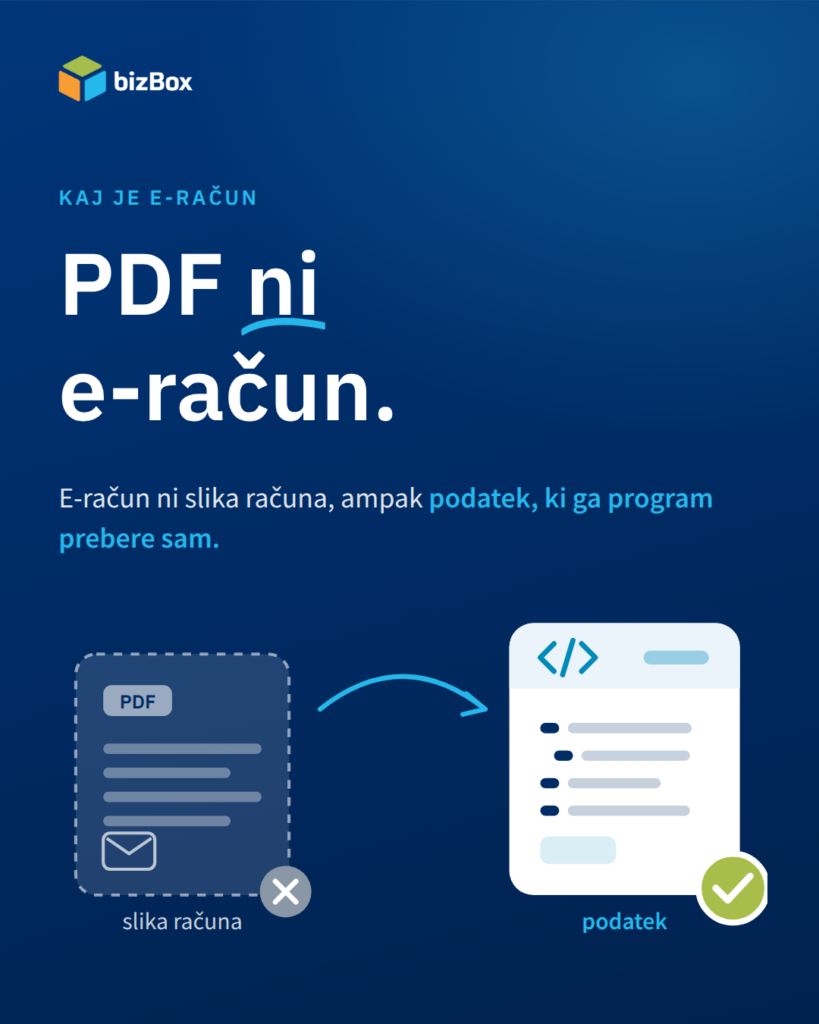
Many companies today create an invoice in a program, save it as a PDF, and send it by email. It looks digital, but it is not an e-invoice. From January 1, 2028, companies in Slovenia will exchange invoices only as e-invoices, so the difference between a PDF and an e-invoice will become important for every company.
An image of an invoice or data
A PDF is an image of an invoice. A person can read it, but a system cannot. The recipient must re-enter the data from the PDF or extract it using an additional tool.
An e-invoice is a structured record. A system reads it automatically: the supplier, amount, date, and line items. That is why it does not need to be re-entered.
What is not an e-invoice
- A PDF sent by email
- An XML file sent as an email attachment
- A scan or photo of an invoice
- An invoice created in Word or Excel
- A paper invoice
What is an e-invoice
- A structured XML file in one of the e-SLOG, UBL, or CII standards
- Sent via an approved channel: through an e-delivery provider
- With proof of delivery
- A PDF may be included, but only as an attachment
Three common misconceptions
“I send the PDF and XML together by email, so it is an e-invoice.” It is not. The format may be correct, but the channel is not. Email is not an approved channel for e-invoices.
“My PDF is the official invoice, and the XML is just an add-on.” It is the other way around. The original is the structured invoice; the PDF is only its visual representation.
“I hardly issue any invoices, so this does not apply to me.” It does. The law applies to issued and received invoices, so every company must also be able to receive e-invoices.
What to watch out for with received invoices
Once you start receiving e-invoices, some suppliers will still send PDFs by email. For such an invoice, please request an e-invoice via an e-exchange provider. This also helps prevent processing the same invoice twice: once as a PDF and once as an e-invoice.
What you gain
Fewer different channels and less manual work. Invoices arrive through an organised channel and in a structured format. There is less re-entry, fewer scans, and more can be processed automatically.